 📷 amNewYork Metro
Op-ed | Addressing the NYC e-bike and e-scooter safety crisis: What should the Council and Mayor do now?
Last month, the City Council convened a marathon oversight hearing on two dozen micromobility bills and resolutions. The proposals include banning the sale of
In the first 10 months of this year , at least 28 people were killed while riding electric bicycles, electric scooters, and illegal “e-motos.” Almost all these crashes involve collisions with cars or trucks.
The NYC Department of Transportation, to its credit, has brought fatal crashes between vehicles and pedestrians to historic lows, a staggering achievement. We must do the same for micromobility users and pedestrians.
Last month, the City Council convened a marathon oversight hearing on two dozen micromobility bills and resolutions. The proposals include banning the sale of Class 3 e-bikes, which have a top speed of 25 mph, making delivery app companies more responsible for the conduct of delivery workers, and calling on the NY State Legislature to pass “Priscilla’s Law,” which would require licensing and registration for all e-bikes and e-scooters.
Although the Council’s hearing ran all day and dozens of people testified, it is unclear what the next steps will be for the City to make micromobility safer.
The Council faces a difficult job because it must solve several complex policy problems at once. The first is the proliferation of illegal high-speed e-motos that resemble e-bikes but operate more like motorcycles. These heavier, faster devices account for more than one-half of micromobility fatalities.
Street enforcement is difficult because police officers cannot readily distinguish illegal e-motos from lawful e-bikes. The most effective response therefore begins at the point of sale.
The Mamdani Administration has cracked down on retail storefronts that sell e-motos and issued cease-and-desist letters to 42 online retailers . If sustained, these efforts will pay off over time. The Council could go a step further and prohibit the sale of Class 3 e-bikes. Although state law currently authorizes these throttle bikes that have a top speed of 25 mph, their motors let riders substantially exceed the City’s 15-mph e-bike speed limit, and they are poorly suited for our crowded bicycle lanes.
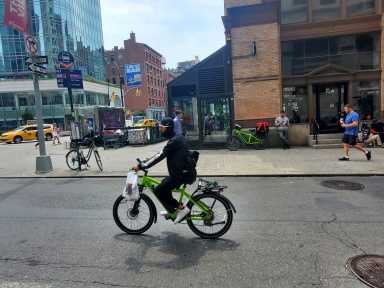
The Council must also address the safety of delivery workers. We all depend on tens of thousands of delivery cyclists to bring us our takeout fast, while it is still hot. These incentives pressure many delivery cyclists to cut corners, run red lights, and ride on sidewalks.
One bill the Council is considering would require delivery app companies to confirm that delivery workers are riding legal e-bikes, not illegal e-motos. The Council is also considering a proposal that would require delivery companies to use technology and trip data to monitor delivery workers’ behavior and intervene if they ride recklessly.
However, there are legitimate implementation concerns being raised by delivery app companies policing independent contractor delivery workers themselves, and in turning over data to the government in terms of privacy violations and the disclosure of trade secrets. Even delivery workers are concerned about due process in terms of being thrown off delivery platforms; similar to what has happened in the ride-hail industry, where drivers are disconnected from Uber and Lyft platforms resulting from passenger complaints.
One way to implement safety technology is to subsidize safe e-bike rentals, as Grubhub already does with JOCO, the New York City company that makes the familiar orange e-bikes rented by delivery workers. The City should encourage or require delivery companies to expand these programs and equip the bikes with speed governors set to the City’s 15-mph limit, along with GPS and other sensors that flag wrong-way riding or riding on the sidewalk.
It is also time we start thinking about alternative approaches to food delivery. The job is dangerous: a Cornell study found that half of delivery workers reported being injured in a crash with a car or truck.
The City should launch a carefully regulated program to test the use of small, remote-piloted sidewalk delivery robots that already make thousands of daily deliveries in cities like Los Angeles, Miami, Chicago, and nearby Jersey City and Hoboken. These delivery robots could handle some local trips without putting delivery workers in traffic. The City must adopt safeguards like low speeds, guarantee pedestrian priority on sidewalks, unobstructed wheelchair access, and public reporting — but we should try what has worked elsewhere.
The NYC Council and the Mayoral Administration should also identify better ways to enforce existing traffic laws – leveraging and using their own technology (existing cameras and data), as opposed to having a knee-jerk reaction imposing unfunded mandates on companies or pursuing last resort measures such as licensing bikes and scooters. DOT analysis shows that 1 in 5 fatal two-wheeled crashes occurred when the e-bike, e-scooter, or e-moto rider ran a red light.
Every pedestrian can see that many e-bike, e-scooter, and e-moto riders think traffic laws simply do not apply to them. The problem is that enforcement is very difficult. Having police officers in squad cars chasing down e-bike or e-scooter riders presents additional safety issues.
News and civic updates are curated for public community information. AI168 maintains an objective, non-partisan platform.← Back to News